Most safety programmes are archaeology: incidents are investigated after the fact, and the corrective action arrives too late for the person it mattered to. PPE detection inverts that by checking protective equipment continuously, as the work happens, and flagging the gap while there is still time to intervene. The question for anyone evaluating it is not whether to detect, but where the eyes should be.
How fixed-camera PPE detection works
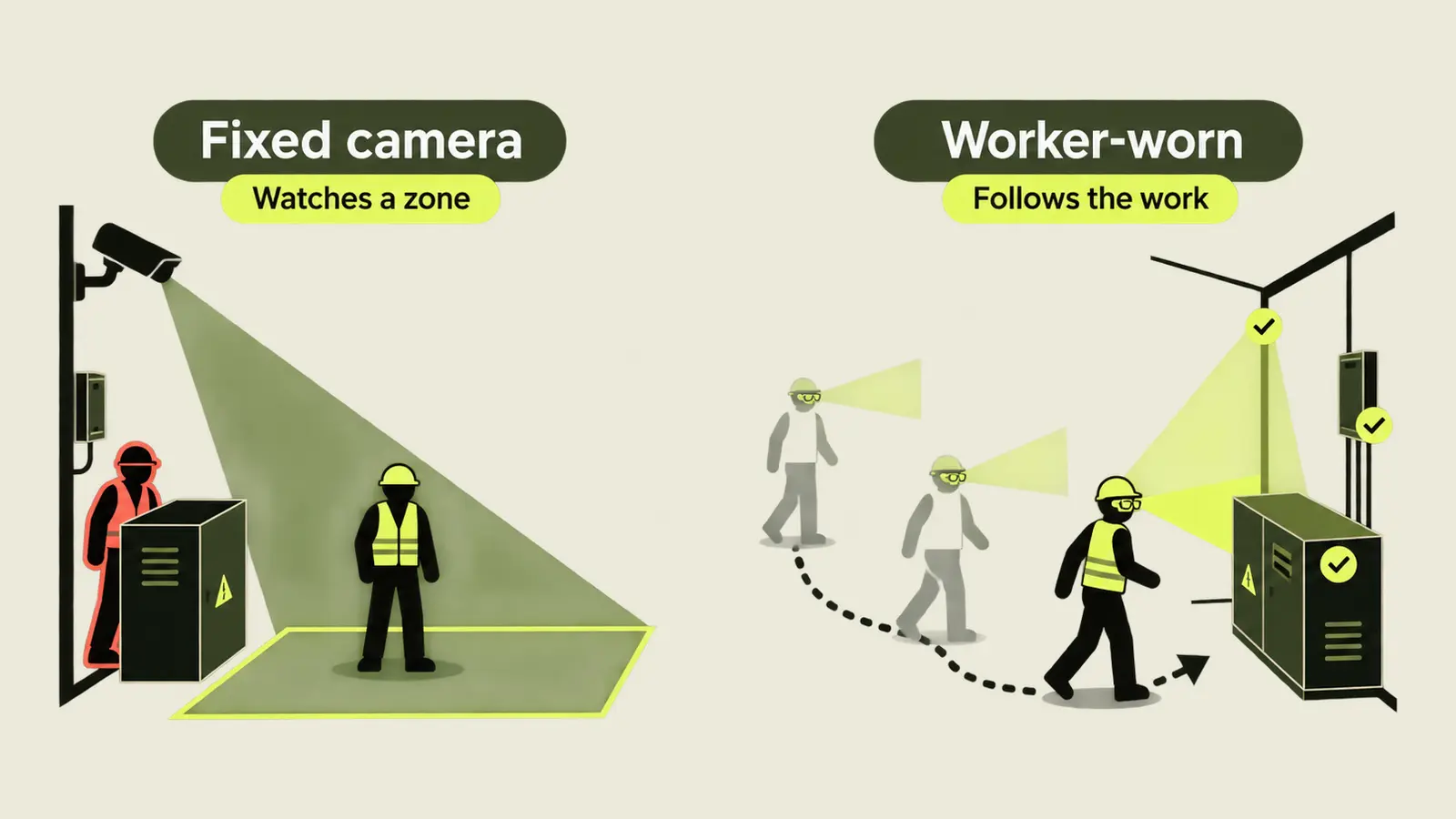
The established approach runs computer vision over CCTV and IP-camera feeds: cameras cover defined zones, models check each frame for hard hats, hi-vis, eye protection, and the rest, and violations raise alerts. Its strengths are real: it reuses camera infrastructure a plant may already have, it covers a fixed zone impartially around the clock, and it needs nothing from the worker. For a stable indoor line with good sightlines, it is a sensible baseline.
Where fixed cameras go blind
- Coverage ends at the frame: a camera watches a zone, not a job. Work that moves, turns a corner, or happens behind equipment happens off-screen.
- Many frontline environments have no fixed infrastructure to mount on: construction floors reconfigure weekly, substations sit hours from the nearest office, underground headings advance away from any cable run.
- Distance and occlusion degrade the checks that matter most. Whether a harness is actually clipped, or eye protection actually seated, or a machine is running that should be offline, is a close-up question that a ceiling camera answers with a guess.
- Every new area is an installation project: the coverage map grows at the speed of conduit, not at the speed of the work.
What changes when detection travels with the worker
The alternative is to run the same computer vision on the devices workers already carry and wear, including smart glasses or wearable devices. The monitoring then follows the work: onto sites where no supervisor can be everywhere, out to the remote substation, down the underground heading. The view is first-person and at working distance, which is exactly where PPE and position questions are decidable. This is how Visor Protect approaches it: missing PPE, unsafe positions, proximity hazards, and developing conditions flagged as they appear, with alerts routed to the right supervisor at the right urgency.
It is not either/or. A strong programme uses fixed cameras for the zones that never move and worker-carried vision for the work itself: the same checks, one record. What matters is that every observation lands somewhere measurable: logged automatically, so near-misses become visible, time-to-intervention becomes a number, and the evidence for ISO 45001, COR, and your regulator exists the moment it is asked for.
Beyond PPE: hazards that develop
PPE is the entry point because it is the easiest thing to verify, but the same continuous watching extends to what actually precedes incidents: moving equipment and exclusion zones, unsafe positions, equipment in the wrong state that could be damaged, environmental conditions developing over minutes rather than frames. The signs are almost always there before the incident, and the programme’s job is to see them in time and to get measurably better at it every quarter.